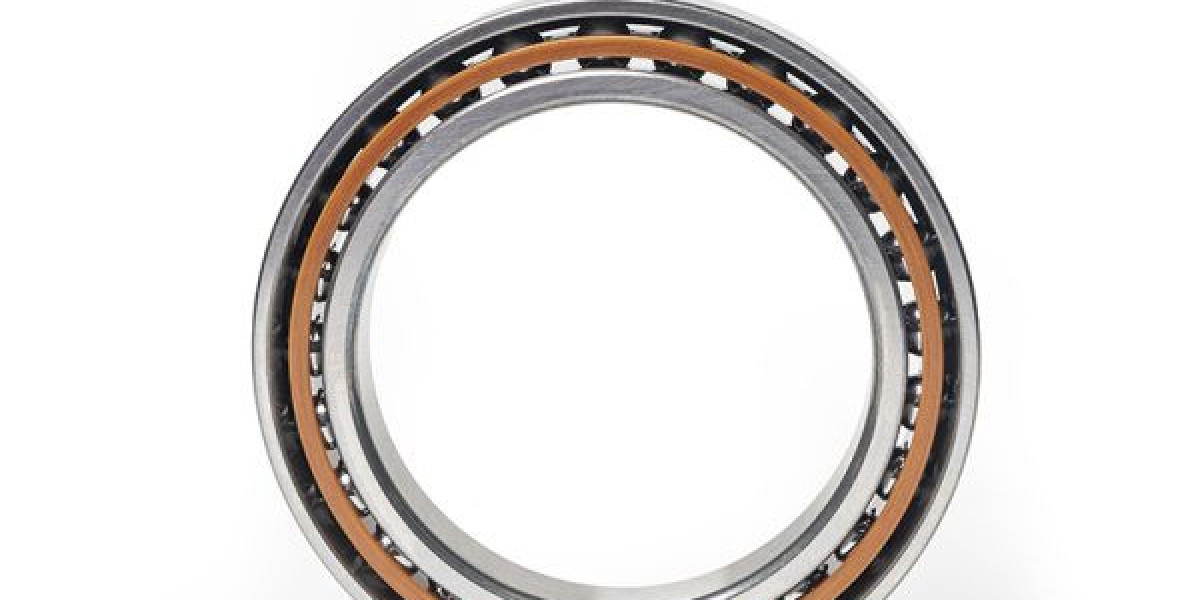

In heavy-duty industrial environments—from petrochemical processing to municipal water treatment—reliability is the only metric that truly matters. As a consultant in the bearing industry, I frequently witness a recurring "failure loop" in high-pressure centrifugal pumps and heavy-gear transmissions.
Maintenance teams often report that their units are vibrating excessively or, worse, the shafts are "walking" (shifting axially) under load. When a standard radial bearing is forced to handle significant thrust, the internal geometry is pushed beyond its design limit. The result? A catastrophic breakdown that could have been avoided with the correct component selection. This is where the 72 angular contact ball bearing becomes the essential upgrade for your heavy-load applications.
The Problem: The Failure of the "General Purpose" Bearing
Many procurement departments default to the 62 series (deep groove ball bearings) because they are common and inexpensive. However, in applications where the fluid pressure or gear meshing creates a constant directional push, a radial bearing is a ticking time bomb.
Raceway Shoulder Damage: Axial force pushes the balls against the edge of the raceway, causing "nicking" and metal fatigue.
Rapid Heat Spikes: The friction caused by misaligned contact points destroys the lubricant’s viscosity in hours.
Shaft Instability: Without axial rigidity, the entire rotating assembly loses its center, leading to seal leaks and mechanical seal failure.
Engineering for Power: The 72 Angular Contact Ball Bearing Advantage
The 72 angular contact ball bearing belongs to the medium-series dimension group. Unlike the lighter 70 series, the 72 series features a thicker cross-section and larger rolling elements. This makes it the "heavy hitter" of the angular contact world, designed specifically for environments where load capacity takes precedence over ultra-high RPM.
1. Robust Load-Carrying Capacity
The defining characteristic of the 72 angular contact ball bearing is its ability to support combined loads (radial and axial simultaneously). The raceways are positioned at a specific contact angle—typically $15^{\circ}$, $25^{\circ}$, or $40^{\circ}$.
A $40^{\circ}$ contact angle (Suffix B) is the most common choice for heavy thrust applications like vertical pumps, as it provides the maximum axial stiffness.
2. High-Capacity Steel and Heat Treatment
Because the 72 series is intended for "punishing" environments, top-tier manufacturers use high-purity, vacuum-degassed steel. Through advanced carbonitriding or specialized heat treatment, these bearings maintain their dimensional stability even when operating in high-temperature gearbox environments.
3. Versatile Universal Matching
Expert-grade 72 angular contact ball bearing units are often "universally matchable." This means they are ground with such precision that they can be mounted in various combinations (Back-to-Back, Face-to-Face, or Tandem) without additional shimming. This "plug-and-play" precision is what separates industrial-grade hardware from hobbyist components.
Troubleshooting: Why Is Your 72 Series Still Overheating?
Even a robust 72 angular contact ball bearing requires proper application to reach its full L10 life. If you are experiencing premature wear, look for these common expert-level "red flags":
Improper Preload Selection
Preload is the internal pressure applied to the bearing to ensure the balls roll rather than skid.
The Problem: Using a "Heavy Preload" in a high-speed application. This creates excessive internal friction and "Blueing" of the steel.
The Solution: For high-speed pumps, a "Light" or "Medium" preload is often sufficient to maintain stability without sacrificing thermal performance.
Mounting Orientation (The "Direction" Error)
An angular contact bearing is a one-way street for axial force. If you install a 72 angular contact ball bearing backwards, the balls will exert pressure on the shallow side of the raceway, leading to immediate failure.
Expert Tip: Always verify the "V" marking or the thrust face indicator on the outer ring during installation.
Strategic Selection: 70 Series vs. 72 Series vs. 73 Series
Understanding where the 72 series fits in the hierarchy is key to your ROI.
| Feature | 70 Series (Light) | 72 Series (Medium) | 73 Series (Heavy) |
| Thrust Capacity | Moderate | High | Ultra-High |
| Max RPM | Ultra-High | High | Moderate |
| Common Use | CNC Spindles | Pumps/Gearboxes | Heavy Industrial Fans |
The "Goldilocks" Component
For most industrial engineers, the 72 angular contact ball bearing is the "Goldilocks" solution. It offers significantly more load-carrying capacity than the 70 series but maintains a higher speed rating than the bulky 73 series. It is the ideal balance for modern high-performance machinery.
Conclusion
Your equipment is an investment, and the bearings are the insurance policy that keeps that investment yielding returns. By transitioning to a 72 angular contact ball bearing for your thrust-heavy applications, you are choosing engineering over luck.
Don't let a simple radial load calculation be the reason your facility goes dark. Analyze your axial thrust, choose the correct contact angle, and ensure your bearings are matched for the rigors of the job. When you prioritize the physics of the 72 series, your machinery will reward you with years of silent, reliable service.